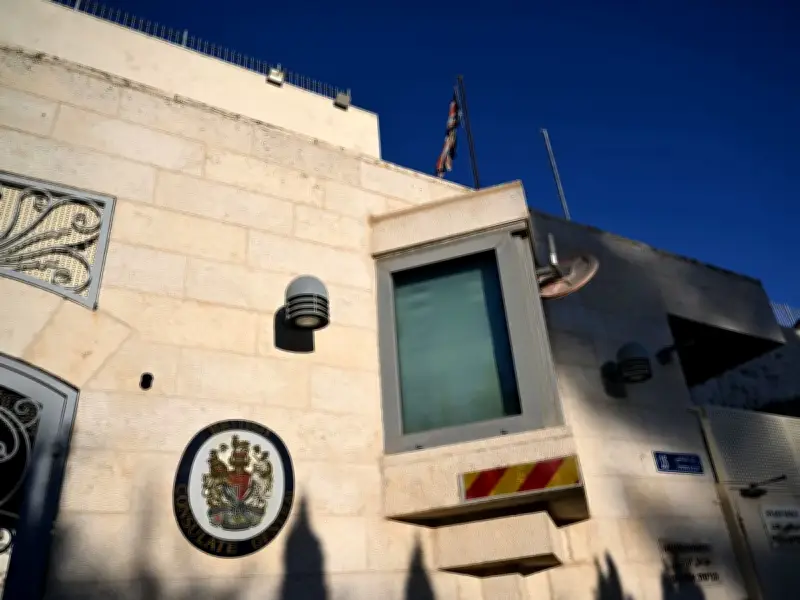
Israel is closing the British consulate in East Jerusalem on Thursday in retaliation for the UK's ban on trade with illegal West Bank settlements. The Israeli government said it would shutter the mission, which represents the UK in the Occupied Palestinian Territories, within 30 days of the sanctions announcement on September 8.
Unless an agreement is reached, the consulate will lose its diplomatic status on Thursday, barring about 30 diplomats from legally operating from the building. The UK Government was believed to be making a last-ditch attempt this week to persuade Israel not to close the consulate, but Israeli foreign minister Gideon Saar said his country would hold firm.
Consulate's role and diplomatic fallout
The consulate, first established in 1838, handles UK relations with Palestinians in the city as well as in the West Bank and Gaza. It is a separate mission to the UK embassy in Tel Aviv, which is the country's main diplomatic interface with Israel.
According to Israeli media, the UK is threatening to expel up to 27 Israeli diplomats if the closure goes ahead. The BBC quoted a Foreign Office official as saying the government department would not comment on “speculation and live discussions” around the possibility of expulsions.
UK sanctions and political context
The retaliation comes after the UK accused the Israeli government of turning a blind eye to the “ethnic cleansing” of Palestinians. Both Israel and the US criticised the UK's stance, which involves a ban on imports from illegal settlements in the West Bank and sanctions on individuals and firms providing services to settlers.
Foreign Secretary Ed Miliband told the Commons that a “new approach” was necessary because plans for the E1 development in the West Bank would render a two-state solution “unviable” by “cutting through the heart of Palestine”. He said the British Government believes the occupation of the West Bank as a whole is unlawful, going beyond the previous position of describing only the settlements themselves as illegal. Mr Miliband also said there is increasing evidence that Israel has committed war crimes in Gaza.
Prime Minister Andy Burnham said the sanctions were “aimed not at the Israeli people, but in support of the two-state solution”. The Foreign Office has been approached for comment.
Arrests at London protests
Elsewhere, 11 people were arrested at pro-Palestine demonstrations in London on Wednesday as protesters clashed on the anniversary of the October 7 attacks. Five people were arrested for inciting racial hatred, involving allegedly shouting or chanting slogans calling for intifada in what the Metropolitan Police described as a “spontaneous protest” outside the Board of Deputies in Camden.
Later, four people were arrested at one of the pro-Palestine student marches and one at a counter-protest in Holborn for breaching the Public Order Act. Another individual at one of the student marches was arrested for common assault, the force said.
Wednesday marked the third anniversary of the attacks on October 7, which saw Hamas-led militants invade Israel, killing some 1,200 people, mostly civilians, and taking more than 250 others hostage. Israel's retaliatory offensive has since killed tens of thousands of Palestinians, destroyed much of Gaza and driven most of its two million residents from their homes.
A number of student pro-Palestine demonstrations took place, despite calls for a ban or for the protests to be moved to a different date. Around 100 pro-Palestine protesters marched and chanted “Free, free Palestine” and “Free the people, free the land” in London, with a group at the back of the march holding a banner reading: “Holocaust survivor descendants against Gaza genocide”. Counter-protesters holding Israeli flags and placards reading “Stop the Gaza genolie” gathered by Russell Square.