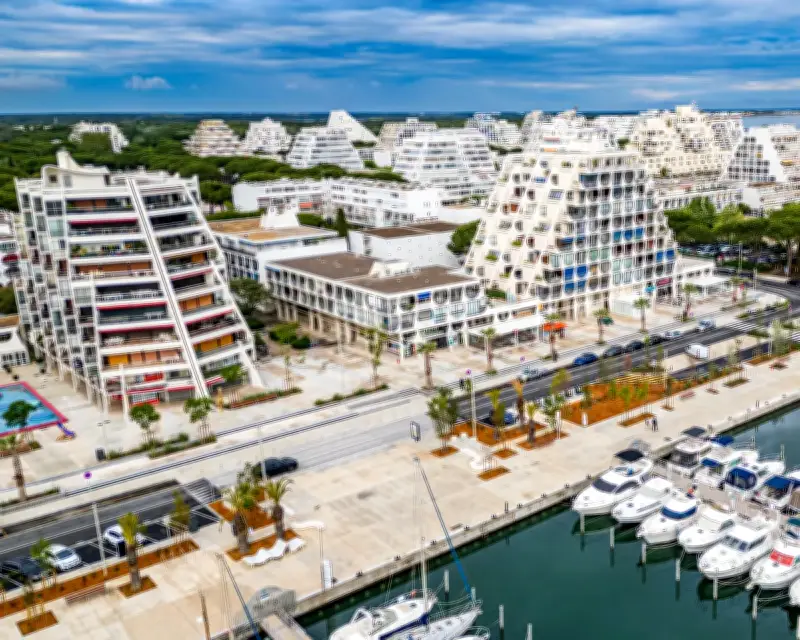
La Grande Motte, a seaside town on the French Mediterranean coast near Montpellier, is drawing attention for its striking retro-futurist architecture, a vision of the future from the 1960s. Once dismissed as a concrete oddity, the town is now being celebrated as a unique example of ambitious postwar urban planning.
A Bold Architectural Experiment
Designed by architect Jean Balladur in the 1960s, La Grande Motte was conceived as a futuristic resort town. Its buildings, shaped like pyramids and ziggurats, were intended to echo the surrounding landscape and provide every apartment with a sea view. The town's name, which means "the great mound," reflects its distinctive pyramidal forms.
Balladur's design was part of a national program to develop the Languedoc coast for tourism. The town was built on former marshland, and its architecture was influenced by pre-Columbian pyramids, as well as the work of Le Corbusier. The result is a dense, car-free center where buildings are clad in a special concrete that ages to a warm, golden tone.

From Derision to Design Icon
For decades, La Grande Motte was often mocked for its unusual appearance. However, in recent years, it has undergone a reevaluation. The town was awarded the "Patrimoine du XXe siècle" (20th Century Heritage) label in 2010, recognizing its architectural significance. Today, it attracts a new generation of visitors interested in modern architecture and the retro-futurist aesthetic.
The town's revival is also linked to a broader trend of "architourism," where travelers seek out buildings and urban environments of architectural interest. La Grande Motte offers a unique opportunity to experience a complete, intact example of 1960s futurism, with its geometric forms, wide pedestrian boulevards, and a marina lined with sculptural buildings.
Living in a Landmark
Beyond its visual appeal, La Grande Motte functions as a living town with a population of around 8,000. Its beaches, marina, and promenades remain popular with holidaymakers, and its architecture is now a source of local pride. The town's cafés and restaurants are housed in the same iconic buildings, allowing visitors to immerse themselves in the retro-futurist atmosphere.
For those interested in seeing a different side of France, La Grande Motte offers a striking contrast to the medieval hilltop villages and classical cities often associated with the country. Its bold, unapologetic architecture stands as a testament to a period of optimism and experimentation, now appreciated as a rare and complete vision of the future.