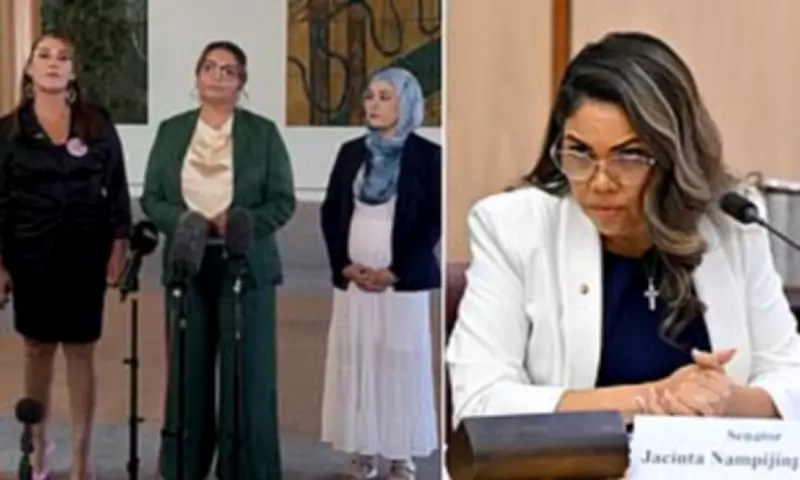
Senator Price Challenges Colleagues Over Racism Allegations in Parliament
Conservative Senator Jacinta Nampijinpa Price has delivered a robust rebuttal to three of her Senate colleagues after they publicly declared that Parliament constitutes a hostile environment marred by systemic racism. Senators Mehreen Faruqi, Lidia Thorpe, and Fatima Payman held a joint press conference on Thursday, asserting that the toxic culture within Canberra's political precincts had forced them to avoid performing their parliamentary duties effectively.
Allegations of Systemic Racism and Demands for Action
The three senators stated they were speaking out to demand concrete governmental action to dismantle what they described as entrenched discrimination within the halls of power. 'Racism is alive in the Senate,' declared Senator Faruqi, adding that when women of colour challenge such behaviour, 'the system turns on us' instead of addressing the perpetrators.
'We are told to sit down and shut up… We are told that we break rules that others can seemingly flout... We are told to be silent when something we say offends white people,' Faruqi continued, painting a picture of a stifling and prejudiced workplace.
Price's Counter-Argument: Rejecting a 'Uniquely Racist' Label
In a sharp response to Daily Mail Australia, Senator Price acknowledged that Parliament should, without question, be a respectful workplace for everyone. However, she firmly rejected the characterisation of the Senate as a 'uniquely racist or hostile place' specifically for women of colour.
'The senators making these claims are often among the loudest and most prominent voices in the chamber themselves, which hardly reflects a culture of being silenced,' Price argued. She emphasised that Australia is a nation built on shared values and equal citizenship, warning that constantly portraying core institutions as racist only serves to divide the Australian people.
'Where genuine discrimination occurs it should absolutely be called out. But not every political disagreement is racism,' she stated, drawing a clear distinction between robust debate and racial prejudice.
Calls for Framework and Enforcement of Existing Rules
The three accusing senators have called on the Labor government to adopt the National Anti-Racism Framework, a comprehensive document released by the Australian Human Rights Commission in 2024 containing 63 recommendations for a society-wide approach to combating racism. Senator Price countered that Parliament already has established rules and behavioural standards to address misconduct.
'The focus should be enforcing those rules, not assuming our democratic institutions are inherently racist,' she asserted.
Senator Faruqi clarified that she welcomes robust political debate but will 'never accept that racism has to be part of my job'. She argued the hostile climate was undermining her full participation in democracy, stating they were merely 'just asking for this parliament to be a safe working place for women of colour like us'.
Personal Accounts and Broader Institutional Critique
Senator Thorpe provided a stark personal account, claiming 'most of the time we choose not to go to the chamber… because there's a known racist in there ready to say terrible, violent, racist things about our people'.
'You've got three Black women who can't even go into the chamber to do their job because the place is too racist,' she said. Thorpe advocated for mandatory anti-racism training, amendments to Senate rules, and strict enforcement of a conduct code that renders racist behaviour unacceptable.
She expanded the critique beyond senators to include parliamentary staff, stating, 'No other workplace allows people to be racist... This isn't just about senators. It's security guards, cafeteria staff, cleaners. There is a problem in this building for everyone who is not white.'
Price's Accusation of Divisive Politics
Senator Price turned the criticism back on her colleagues, arguing it is the three senators themselves who are inappropriately focused on racial identity.
'These activist senators need to stop invoking divisive identity politics and playing the victimhood card,' Price said. 'Australians are tired of divisive identity politics. They expect their representatives to focus on the issues that affect their daily lives.'
Context of Recent Parliamentary Incidents
These heated exchanges follow a series of incidents that have intensified scrutiny over parliamentary conduct. Earlier in March, One Nation leader Pauline Hanson refused to withdraw or apologise for calling Senator Thorpe a 'b***h' during a fiery debate, later stating she did not 'take back' her words. Footage from the chamber showed Thorpe responding, 'I just got called a b***h by the racist.'
This clash occurred during a debate on the Middle East, where Hanson also labelled the Greens, Thorpe's former party, as 'un‑Australian'. Separately, Senator Faruqi pursued successful legal action against Hanson over a 2022 social media post in which Hanson told her to 'p*** off back to Pakistan'. In 2024, the Federal Court ruled that Hanson's remarks constituted racial discrimination under section 18C of the Racial Discrimination Act.
Appeal for Government Leadership
Concluding the press conference, Senator Payman called on the government to demonstrate leadership, criticising Prime Minister Anthony Albanese for failing to adequately confront harmful conduct and for allowing 'hateful' voices to be heard. She urged the implementation of the national anti-racism framework to ensure 'every single person feels safe, both in the chamber and outside it.' The federal government has not yet confirmed whether it will adopt the framework's recommendations.