

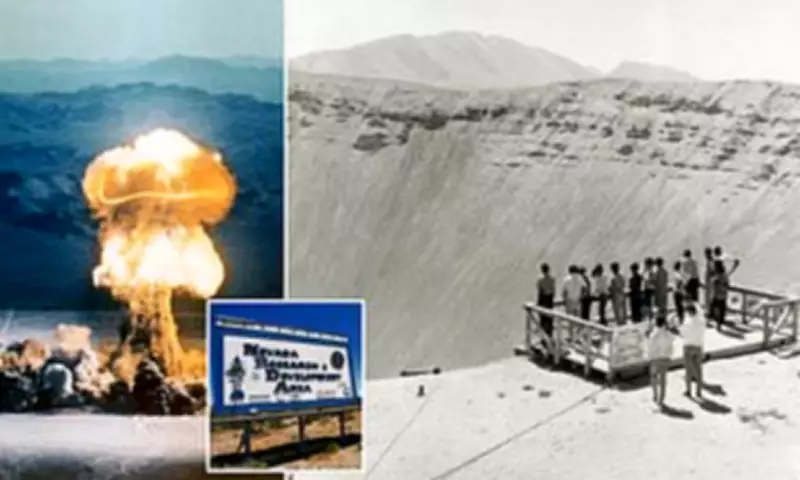
The Nevada National Security Site (NNSS), a sprawling 680-mile stretch of desert that became synonymous with Cold War nuclear testing and public fear, has announced the cancellation of all future tours due to funding uncertainty. The site’s website states: 'Due to funding uncertainty, public tours of the Nevada National Security Site have been canceled through 2026. Going forward, public tours will be evaluated dependent on the budget situation at that time.'
End of an Era for a Chilling Destination
For decades, the NNSS offered public tours that could accommodate up to 50 guests at a time, covering 250 miles of the vast desert landscape. At its peak, the tours attracted over 10,000 visitors annually. Patrons were shown sites such as Mercury, a base camp 65 miles northwest of Las Vegas that served as living quarters for civilian and military test personnel from 1951 to 1992. This mini town featured its own Olympic-size swimming pool and a popular bowling alley, bustling with life for over 40 years. Today, many of Mercury’s structures have been demolished or repurposed.
Iconic and Eerie Attractions
One of the most jaw-dropping sites was the Sedan Crater, formed in 1962 after a 104-kiloton thermonuclear device was detonated underground. The blast created a crater 1,280 feet in diameter and 320 feet deep—roughly the size of four football fields and as deep as a 30-story building. It dispersed 12 million tons of earth and released seismic energy equivalent to a magnitude 4.75 earthquake. According to the NNSS, the crater was a popular spot, at one point drawing more than 10,000 tourists per year. In 1994, it was listed on the National Register of Historic Places.

Another eerie attraction was the replica cities built to simulate the effects of a nuclear blast on a typical American community. The Annie test, conducted in 1953, was the first nuclear test to be nationally televised. Two colonial two-story homes were constructed 3,500 and 7,500 feet from a 300-foot tower holding a 16-kiloton device. The homes, fitted with mannequin appliances and food, were badly damaged; the house at 3,500 feet was 90 to 95 percent destroyed. Both houses were later demolished. Similar sites, such as the Apple 2 Houses, were also built to test blast impacts. These test sites inspired the popular Call of Duty: Black Ops map Nuketown.
The tours were conducted monthly to educate the public on how the site has evolved over the years. The Daily Mail has reached out to the NNSS for comment.






