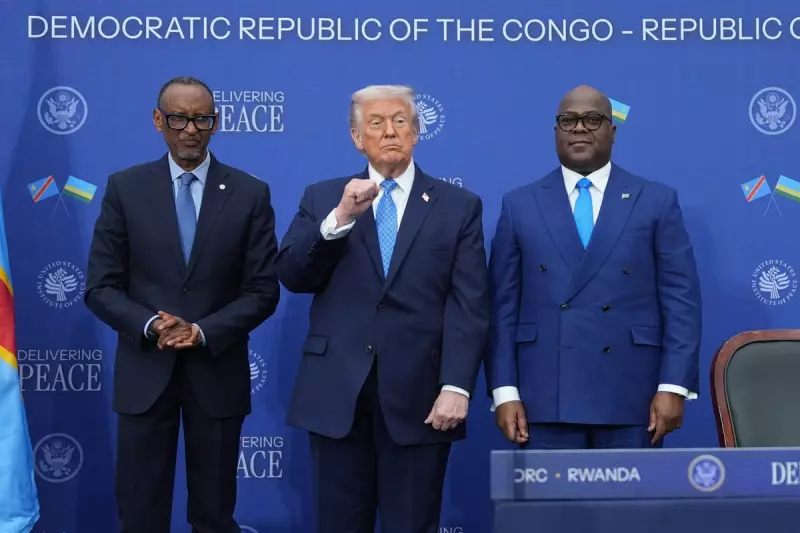
US President Donald Trump has presided over a high-profile signing ceremony in Washington, bringing together the leaders of the Democratic Republic of Congo (DRC) and Rwanda to endorse a peace and economic agreement. The event on Thursday, 4 December 2025, saw DRC President Felix Tshisekedi and Rwandan President Paul Kagame commit to a US-brokered peace accord and an economic integration compact.
A Ceremony Amidst Conflict
While the leaders signed documents before a "Delivering Peace" backdrop at the United States Institute of Peace, clashes between the Rwanda-backed M23 rebel group and the Congolese army were reported in South Kivu province. Analysts noted the diplomatic event had paused major escalation but failed to resolve the conflict's root causes. M23, which is not bound by the new agreement, accused government troops of bombing civilian areas.
"We're settling a war that's been going on for decades," President Trump declared. "They spent a lot of time killing each other, and now they're going to spend a lot of time hugging, holding hands, and taking advantage of the United States of America economically." The ceremony provided Mr Trump with a televised diplomatic victory, a narrative starkly contrasted by the bloody reality on the ground in Central Africa.
The Scramble for Resources and Stalled Peace
The Washington deal also includes a critical minerals agreement, highlighting the economic interests at play. The DRC is the world's largest producer of cobalt and a leading supplier of coltan, minerals essential for electric vehicles, smartphones, and advanced electronics. The United States is keen to secure access to these resources to counter China's dominance in the sector.
However, Nobel Peace laureate Denis Mukwege condemned the accords, stating they were driven more by a scramble for minerals than a genuine desire for peace. "The proof: this morning, in my native village, people were burying the dead while a peace agreement was being signed. The M23 continues to seize territory," he said from Paris.
Decades of Conflict and Core Grievances
The current violence traces its origins to the aftermath of the 1994 Rwandan genocide. The M23, composed primarily of ethnic Tutsis, claims to defend Tutsi communities in eastern DRC from discrimination. Rwanda denies backing the group, though UN experts stated in July that Kigali exercises command-and-control over the rebels, who now number around 6,500 fighters.
A White House official said the signing "recommits the parties to the peace process," reflecting months of diplomacy where Trump made it clear the status quo was unacceptable. Yet, with M23 absent from the Washington talks and participating in separate Qatar-mediated negotiations, and with both sides accusing each other of ceasefire violations, the path to lasting peace remains fraught.