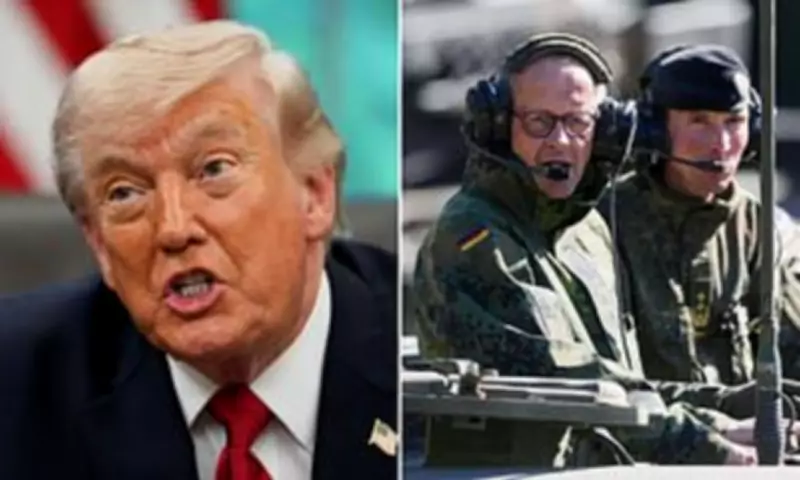
US President Donald Trump has unleashed another attack on German Chancellor Friedrich Merz in a furious social media post, calling him an 'ineffective' leader. The US president is continuing to pillory Merz, who has been increasingly critical of the US-Israel war against Iran.
In a post on Truth Social, Trump said Merz 'should spend more time on ending the war with Russia/Ukraine' and 'fixing his broken Country, especially Immigration and Energy' rather than concerning himself with the Middle East conflict.
The latest criticism came the day after Trump announced he was reviewing the US military presence in Germany, a NATO ally that hosts several American military installations. The spat began on Monday when Merz said during a school visit that Washington was being 'humiliated' by Tehran and had prosecuted the war without a viable exit strategy, comparing it to past issues in Afghanistan and Iraq. He also lamented that the conflict was detrimental to Germany's economy, saying it was 'costing us a great deal of money'.

Trump lashed out on Truth Social, writing: 'The Chancellor of Germany, Friedrich Merz, thinks it's OK for Iran to have a Nuclear Weapon. He doesn't know what he's talking about!'
Merz sought to cool tensions on Wednesday, insisting their relationship remains strong. 'The personal relationship between the American president and me remains, in my view, as good as ever,' he said at a press conference. 'We are still, to put it in American English, on good speaking terms.' He framed his criticism as a response to the conflict's economic fallout, citing soaring energy costs and economic strain from the closure of the Strait of Hormuz.
While Germany backed the war when it started on February 28, the government's tone has hardened as the conflict escalated. Berlin rejected Washington's calls for transatlantic military involvement, insisting the conflict 'is not NATO's war,' and has only offered a limited role, including minesweepers to help secure the Strait of Hormuz once fighting stops.
Now, Washington is considering reducing US troops in Germany as punishment for lack of support. 'The United States is studying and reviewing the possible reduction of Troops in Germany, with a determination to be made over the next short period of time,' Trump said on Truth Social. The US had just over 68,000 active-duty military personnel assigned permanently in its overseas bases in Europe as of December 2025, data from the US Defence Manpower Data Center shows. More than half—about 36,400—are based in Germany, a fraction of the 250,000 US troops stationed there in 1985.
Trump sought a major reduction in US troop levels in Germany during his first term, although that was never realised, said Jeff Rathke, a former US diplomat and president of the American-German Institute at Johns Hopkins University. Rathke said the US military benefitted greatly from having a forward presence at bases overseas, including Ramstein in Germany. 'US forces in Europe are not a charitable contribution to ungrateful Europeans – they are an instrument of America's global military reach,' he said.
Iran said on Thursday it would respond with 'long and painful strikes' on US positions if Washington renewed attacks, and reasserted its control over the Strait of Hormuz, complicating US plans for a coalition to reopen the waterway. Two months into the war, the vital sea channel remains closed, choking off 20 per cent of the world's oil and gas supplies, sending global energy prices surging and heightening concerns about an economic downturn.
Efforts to resolve the conflict have hit an impasse, with a ceasefire in place since April 8 but Iran still blocking the strait in response to a US naval blockade of Tehran's oil exports. Trump is slated to receive a briefing on Thursday on plans for fresh military strikes on Iran to compel it to negotiate an end to the conflict. Such options have long been part of the Pentagon's planning but the proposed briefing spurred big gains in oil prices, with Brent crude hitting more than $126 a barrel at one point before slipping back to around $113.

Any US attack on Iran, even if limited, will usher in 'long and painful strikes' on US regional positions, a senior Revolutionary Guards official said. 'We've seen what happened to your regional bases, we will see the same thing happen to your warships,' Aerospace Force Commander Majid Mousavi was quoted as saying by Iranian media.