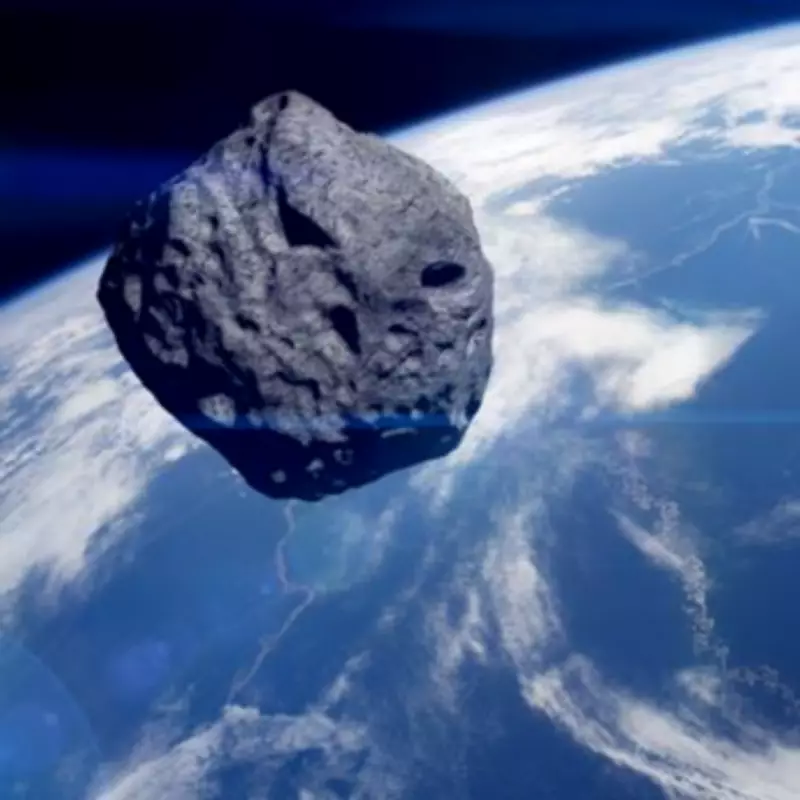
A massive asteroid roughly the size of a five-a-side football pitch made a close approach to Earth just days after its discovery by astronomers. Designated 2026 JH2, the space rock was first detected by the Mount Lemmon Survey in Arizona last week and was quickly classified as a near-Earth asteroid. On Monday evening, it sailed through the Moon's orbit, coming within 50,000 miles of our planet—approximately one quarter of the distance to the Moon.
Size and Visibility
Observers estimate the asteroid measured between 16 and 35 metres in diameter, making it too small to be seen with the naked eye. However, it was visible through telescopes in various parts of the world, particularly in the southern hemisphere. The asteroid's rapid motion across the sky—roughly a third of a degree per minute—meant that without tracking, it would streak through a telescope's field of view in seconds.
No Impact Risk
Despite being classified as a potentially hazardous object due to its size, 2026 JH2 posed no threat to Earth. Encounters of this kind are rare, with only five known space rocks expected to pass inside the Moon's orbit in the coming year. Mark Norris, a senior astronomy lecturer at the University of Lancashire, told BBC Sky at Night Magazine: "If it entered Earth's atmosphere, an asteroid of this scale would still be capable of causing serious regional damage. For example, the Chelyabinsk meteor that exploded over Russia in 2013 was thought to be of a similar size, and despite breaking apart before reaching the ground, it damaged buildings across hundreds of square miles."

Future Passages
According to the European Space Agency, 2026 JH2 will not return to Earth's vicinity until 2060, and its next pass will be at a much greater distance. The asteroid's size is comparable to the Chelyabinsk meteor, which exploded over Russia in 2013, shattering windows and injuring an estimated 1,500 people. While fragments of that meteor reached the ground, they did not strike populated areas.