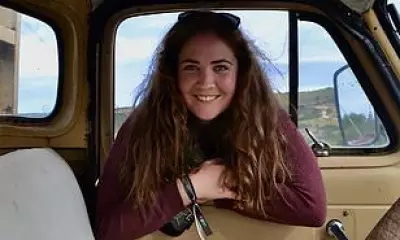
A mother of two whose small stomach lump was dismissed by doctors as 'probably nothing but a muscle tear' has revealed that the symptom later turned out to be stage four ovarian cancer.
At 38, Vanja Wilson was busy balancing family life and a demanding career as a general manager at a tech company when she noticed what felt like a small marble beneath the skin of her abdomen. 'It was about five centimetres under my belly button,' Vanja told the Daily Mail.
Concerned, the Sydney mum visited two different doctors in August and October of 2023 to ask what it could be. 'They said it was nothing, probably scar tissue from having two C-sections,' she said. Doctors referred her for an external ultrasound, which came back with 'no concerning results', suggesting it looked like a muscle tear. 'They just said nothing to worry about, but if I really wanted to, I could pay $700 to have an MRI, which would obviously be quite expensive for something that no one seemed to be worried about, so I left it for a good six to seven months.'

Although the lump remained, Vanja said she pushed aside any lingering concern. 'In my head, I always kind of thought, well, is it just me, or is this growing a little bit? But I wasn't worried because no one else was.' Looking back now, she can see there were other warning signs, though at the time they felt easy to explain away. 'I was bloated quite often, and experiencing a bit of discomfort in that sense, but I just put it down to being lactose intolerant, or something of that nature,' she said. 'I was feeling very energetic, and didn't feel tired in any way, didn't have any other obvious symptoms.'
It was not until months later, when she noticed blood in her stool, that she realised something was seriously wrong. 'My mum has a history of bowel disease,' she said. 'It happened twice, and the second time it was undeniable that something wasn't quite right.' Vanja returned to her GP and insisted on a colonoscopy. Within weeks, doctors discovered a tumour almost entirely blocking her bowel. 'The doctor told me it was either bowel cancer or ovarian cancer - but we had to wait for results from the biopsy to confirm.'
The devastating news came on May 10, 2024, just before Mother's Day. 'I had to call my husband and ask him to pick me up, and tell him over the phone that I had cancer.' They discovered that she had three tumours. One had started in the ovary, then it had travelled into the bowel and into the abdominal muscle at the front. Because the bowel was close to fully obstructed, surgeons moved quickly. 'I was only allowed to eat soup after that, because they were worried about a blockage.'
On June 4, 2024, Vanja underwent a gruelling five-hour surgery at Royal North Shore Hospital. The operation involved a radical hysterectomy, bowel resection, and removal of tumours throughout the abdomen and diaphragm. Despite the scale of the operation, surgeons considered it successful, removing all visible traces of cancer. Still, pathology results confirmed the disease had reached stage four because it had spread outside the abdominal cavity.
Only three weeks after surgery, Vanja began 16 rounds of weekly chemotherapy. 'There was no time to really recover,' she said. 'It was just straight into the next treatment.' Determined to keep moving, she stayed active throughout the early stages of treatment, but eventually the physical toll became overwhelming. 'The main symptoms for me were the nerve damage that can happen,' she said. She developed severe neuropathy that caused an unbearable itching and tingling sensation beneath her skin. 'I had to sit in ice baths just to numb my hands and feet daily, probably every two hours, just to get by,' she said. 'I couldn't go for walks, I couldn't drink a hot cup of coffee and I couldn't even shower towards the end without triggering it.'

Alongside the nerve damage came crushing fatigue, swelling caused by steroids and the loss of her sense of taste. 'With every dose, you just kind of took a bigger hit in the body.' One thing she fought hard to preserve was her appearance, particularly for her young daughters, who were just four and seven at the time. Vanja chose to use cold-cap therapy during chemotherapy to try to keep her hair. 'You still have to sit there with the cap, which basically gives you brain freeze,' she said. 'But being able to maintain a portion of my identity through doing that helped significantly.'
She said explaining the illness to her daughters was one of the hardest parts of the experience. The family, originally from Sweden and England, had no relatives nearby in Australia and relied heavily on friends for support during treatment. Her eldest daughter already associated the word 'cancer' with loss after Vanja's father died from lung cancer several years earlier. At the same time, her mother survived breast cancer. 'We could say to her that there are different types to hopefully alleviate some of her worry.'
Vanja finished chemotherapy in October 2024 and began taking a drug called Niraparib in January 2025 to help reduce the risk of recurrence. Because she does not carry the genetic mutations typically required for government subsidies, the medication is not publicly funded for her. The family withdrew money from superannuation to cover the cost. 'I am paying for it out of my own pocket, which is $6,000 a month,' she said. Although the medication caused severe side effects initially - including requiring a blood transfusion - she says her body has since adjusted. 'I am as symptom-free as I've probably been since my diagnosis,' she said. 'I've managed to maintain my remission. I have no evidence of disease.' Still, the fear of recurrence remains ever-present. 'At stage four, the chances of recurrence are as high as 90 per cent.'
Throughout the ordeal, Vanja sought psychological support through the Cancer Council NSW and Ovarian Cancer Australia, but eventually found the greatest comfort in advocacy and fundraising. As her chemotherapy journey came to an end, friends encouraged her to participate in Frocktober, a fundraising campaign run by the Ovarian Cancer Research Foundation. 'We raised $25,000 in that one,' she said. 'I was angered by the statistics that I had obviously been confronted with, and the lack of funding from the government for this type of cancer.'
She now regularly speaks publicly about ovarian cancer awareness and research funding, determined to help other women recognise symptoms earlier than she did. 'I often say this when I do my advocacy for ovarian cancer, that whilst the symptoms are extremely vague, I do think that if I had had a bit more awareness, I would have taken my symptoms more seriously,' she said. 'I would have advocated for myself a bit more when I was in those GP rooms being told that it was nothing.'
Ovarian cancer is often referred to as a 'silent' disease because symptoms can mimic common digestive or hormonal issues, including bloating, abdominal discomfort, feeling full quickly, and changes in bowel habits. There is currently no reliable early detection test. 'The only real way of change is through research,' Vanja said. 'Both from an early detection and an actual treatment standpoint.' Australians wanting to support ovarian cancer research or learn more about symptoms and support services can visit the Ovarian Cancer Research Foundation.