Nationwide Campus Protests Challenge Trump's Education Agenda
In an unprecedented display of unity, students, faculty, and staff at more than 100 universities across the United States staged coordinated protests on 7 November 2025. The demonstrations marked the first major organised response to what participants describe as the Trump administration's assault on higher education and academic freedom.
A Coalition of Resistance Forms
The day of action was coordinated under the banner of Students Rise Up, a network incorporating both local student groups and national organisations including the Sunrise Movement and Campus Climate Network. They were joined by prominent educational workers' unions such as the American Association of University Professors and Higher Education Labor United, creating a powerful coalition of resistance.
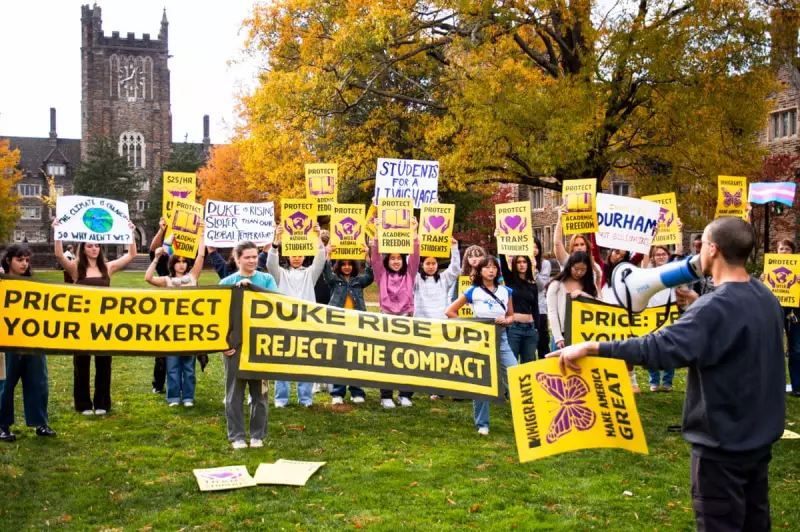
Protesters directed their anger at what they termed Trump's "compact" - an initiative offering universities preferential access to federal funding in exchange for advancing the administration's conservative agenda. Only one institution, New College of Florida, has accepted this compact to date, following its transformation into a conservative bastion by state legislators.
"Universities should be a place of learning, not propaganda machines," stated Alicia Colomer, managing director at Campus Climate Network, ahead of the protests. "That's why students, workers and alumni around the country are taking action."
Diverse Demands and Creative Protests
As the day unfolded, hundreds of students participated in walkouts, unfurled banners, and held rallies across the country, often supported by faculty and staff. Beyond condemning the administration's compact, protesters advocated for more affordable education and protection for all students, particularly transgender and international scholars.
At the University of Kansas, approximately 70 students demanded their administration divest from weapons manufacturers and Israel, refuse collaboration with ICE, safeguard gender-affirming housing, and meet faculty demands for fair contracts.
In a striking visual protest at Duke University in North Carolina, professors taped their mouths shut to symbolise the silencing effect of Trump's policies. They held signs demanding the university support immigrants, pay workers a $25 hourly wage, and protect trans and international students.
Brown University in Rhode Island, which had previously reached a settlement with the Trump administration, hosted an interactive protest where passersby endorsed demands by dipping their hands in paint and leaving prints on a banner, while faculty members nearby lectured about the history of autocracy.
"Trump came to our community thinking we could be bullied out of our freedom," said Simon Aron, a sophomore and co-president of Brown Rise Up. "He was wrong."
Targeting Billionaire Influence
In New York City, students and faculty from multiple institutions gathered outside the midtown headquarters of Apollo Global Management to protest CEO Marc Rowan, a billionaire Trump donor identified as a key architect of the controversial compact.
Protesters criticised Rowan's involvement with the online University of Phoenix, which they described as "the largest single producer of student debt in the country," and his role in facilitating the use of civil rights legislation to target universities over criticism of Israel.
The firm reportedly instructed staff to work from home in anticipation of the protest. In a recent New York Times op-ed, Rowan defended the compact, arguing that American higher education is "broken" and requires "course correction from the outside."
Amy Offner, a history professor at the University of Pennsylvania, told The Guardian that the campaign against Rowan represents a broader effort to protect US higher education from ultra-wealthy individuals. "Billionaires should not control what can be taught and studied in the United States," she asserted.
A Growing Movement with Ambitious Plans
These coordinated protests represent just the beginning of a planned series of nationwide actions. Organisers aim to build momentum toward large-scale student and worker strikes on May Day next year, culminating in a nationwide general strike in May 2028.
Todd Wolfson, president of the AAUP, emphasised the significance of this united front during a call with protest organisers last week: "There is only one way forward in saving higher education and democracy writ large and that is students, faculty, staff united. We have to become a new political force."
This unprecedented coordination between students, faculty, and staff signals a potentially transformative moment for both higher education and political activism in the United States, as academic communities mobilise to defend institutional autonomy and democratic principles.