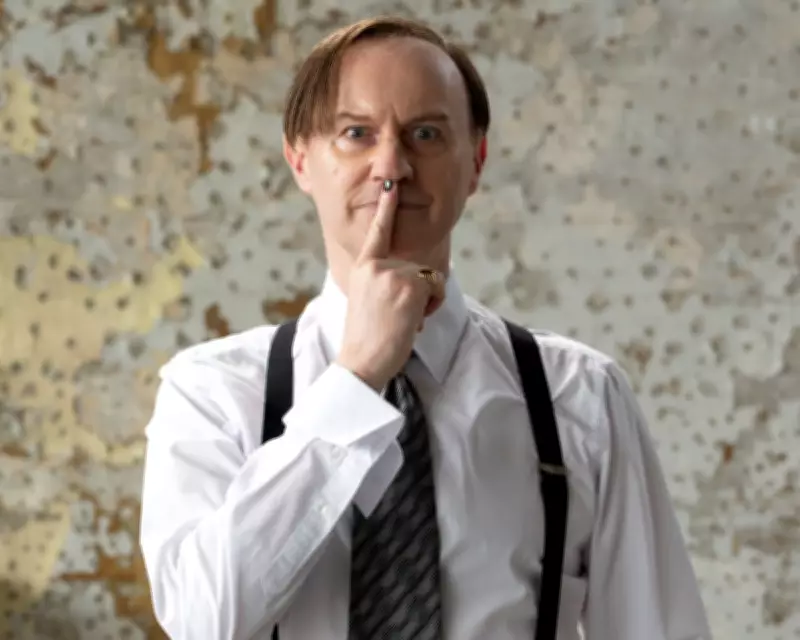
Mark Gatiss and Placebo Revive Brecht's Hitler Satire Amid Modern Parallels
In a striking revival of Bertolt Brecht's 1941 satire, The Resistible Rise of Arturo Ui, the Royal Shakespeare Company brings together actor Mark Gatiss and alt-rock band Placebo to explore the unsettling echoes between historical fascism and contemporary politics. This production, directed by Seán Linnen, arrives at a time when political rhetoric in Britain and beyond mirrors the dangerous language of the past, making Brecht's work feel alarmingly prescient.
Uncanny Parallels to Current Events
During rehearsals, the cast has delved into the uncanny similarities between Brecht's allegorical tale of a Chicago gangster's rise to power and modern political discourse. Gatiss, who portrays the titular Arturo Ui, notes that the rhetoric used by figures like Hitler, who described Germany as diseased, is being replicated today. "It's the same rhetoric," Gatiss says. "You just give it 80 years. The second world war generation has died out, so it's fertile ground again. The same bullshit works. It's really frightening." He references recent statements by politicians and public figures, such as Nadhim Zahawi's description of the UK as sick and Elon Musk's warnings of violence, which align verbatim with themes in the play.
A Timely Warning from History
Brecht wrote the play after fleeing Germany when Hitler became chancellor, presenting the Nazi dictator's rise as enabled by capitalist corruption. The RSC's production, translated by Stephen Sharkey, avoids tying the lead to a specific modern dictator, instead letting the parable speak for itself. Gatiss emphasizes that the text's lines resonate deeply with current events, prompting the team to accelerate the production timeline. "We said: 'We should be doing it tomorrow, shouldn't we?'" he recalls. "It was a warning from history. Now it's the bloody news." The play uses the absurd allegory of Ui controlling the cauliflower market to mirror Nazi coercion tactics, with rehearsals experimenting with props like fish and baguettes to highlight the brutality.

Placebo's Musical Contribution
Placebo, comprising vocalist Brian Molko and bassist Stefan Olsdal, provides the score for this production, marking their theatre debut. Molko explains that the play's themes align perfectly with the band's politics, as they observe demagogues disregarding international law. "We're seeing the world run by these demagogues with no respect for international law," Molko says. "This play speaks to us watching these horrific things unfold on a daily basis and trying not to lose hope." Olsdal adds a sobering reflection: "We think we learn from history, but history shows us that we don't." The music, composed with musical director Alex Lee, ranges from brief, intense pieces to longer, abrasive rock segments, designed to enhance the story's immediacy.
Creative Freedom and Historical Context
Director Seán Linnen's approach defies the rigid perceptions often associated with Brecht's works, allowing for creative experimentation. Gatiss notes that the production is not a dry, didactic exercise but rather a comic nightmare with a carnival atmosphere. This freedom extended to Placebo, who were given no rules in composing the score, a departure from their usual process where music takes a leading role. Gatiss also discusses his evolving view of Brecht, influenced by John Fuegi's biography, which credits the women in Brecht's life for much of his work. "He's sort of a brand name," Gatiss remarks, advocating against treating the text as holy writ, similar to Shakespeare.

A Call to Action Beyond the Choir
Despite the RSC's base in Warwickshire, led by Reform UK, Gatiss hopes the production reaches beyond typical theatre audiences. "I would like to think we are not just preaching to the choir," he says, emphasizing the practical need for hope in turbulent times. The play's epilogue, which urges action against fascism, remains a powerful moment for Gatiss. "I'm not suggesting someone's going to walk in and tear up their Britain First membership in front of us, but you have to do something. Go down swinging, at least." The production runs at the Swan Theatre in Stratford-upon-Avon from 11 April to 30 May, offering a timely reflection on resistance and history's lessons.