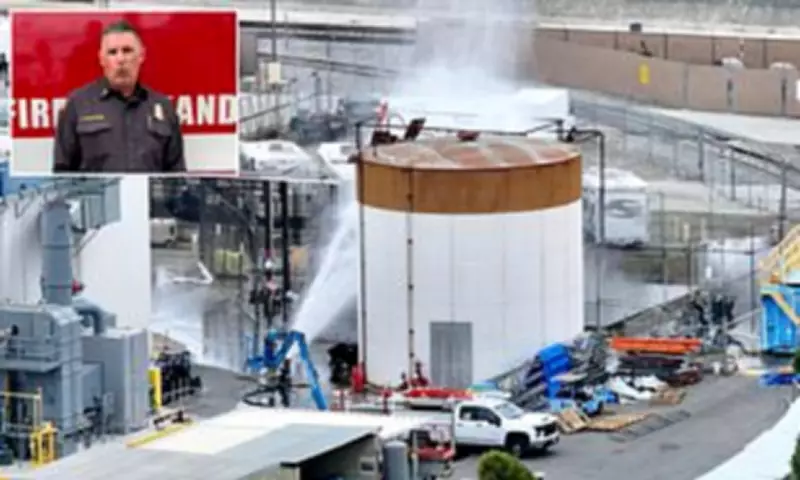
California officials have revealed a critical update regarding a chemical tank at an aerospace facility that is on the verge of exploding. The Orange County Fire Authority (OCFA) reported Sunday that a specialized team discovered a potential crack in the 34,000-gallon tank at the GKN Aerospace facility in Garden Grove.
Discovery of the Crack
Interim Fire Chief TJ McGovern stated in a video posted to X: 'During that operation, our firefighters went in and were able to visualize the tank. What they found was a potential crack in the tank.' This crack could 'potentially be relieving some of the [tank's] pressure,' but McGovern assured that the team is 'vetting and validating' the new information.
As new details emerged, officials indicated that they might change their strategy to focus on preventing a toxic explosion. 'Last night was a successful operation for this emerging incident. There's going to be a lot more information coming today as we vet and validate all that information,' McGovern added.

Background of the Incident
A toxic leak was reported Thursday at the GKN Aerospace facility after a tank began leaking methyl methacrylate (MMA), a highly flammable chemical used to make acrylic plastics. Schools in the area have been closed, and approximately 50,000 people have been evacuated from around Garden Grove since the leak was reported.
Officials have been monitoring the tank's internal temperature, which has been rising by about one degree every hour since Thursday morning. The cause of the overheating remains unknown. Efforts to contain the leak have been unsuccessful, and officials previously warned that the tank could 'rupture or explode.'
Blast Zone Map
On Saturday, officials released a map showing potential blast zones should the tank explode. The severe damage blast zone, the innermost circle, represents areas where 'severe structural damage and significant harm' are expected. Surrounding zones include moderate and light damage areas. A dark red oval indicates flammable conditions, while an orange oval marks areas immediately dangerous to life and health.
Orange County Fire Authority Division Chief Nick Freeman warned that the chemical poses severe health risks, particularly to the respiratory system. 'Respiratory is our primary concern, so it's a respiratory irritant,' he told KTLA. 'It can start off very mild but it can progress to a point where you would probably require hospitalization, if not more.'
Orange County Health Officer Dr. Regina Chinsio-Kwong added that inhaling the vapor could cause dizziness, nausea, and severe respiratory distress at high levels. She stressed that the evacuation zone was based on a worst-case scenario and urged residents to stay away from evacuated areas. 'If you are not in the evacuation zone, you do not need to worry,' she said, noting that masks are not necessary.
The final and largest area on the map is the yellow oval zone, considered non-hazardous but marking the odor threshold. The chemical has a strong, fruity scent, but smelling it does not necessarily indicate health impacts, according to Chinsio-Kwong.
Ongoing Operations
Interim Fire Chief McGovern concluded that more information will be released 'shortly.' Officials continue to monitor the situation and adjust their response as new data emerges.