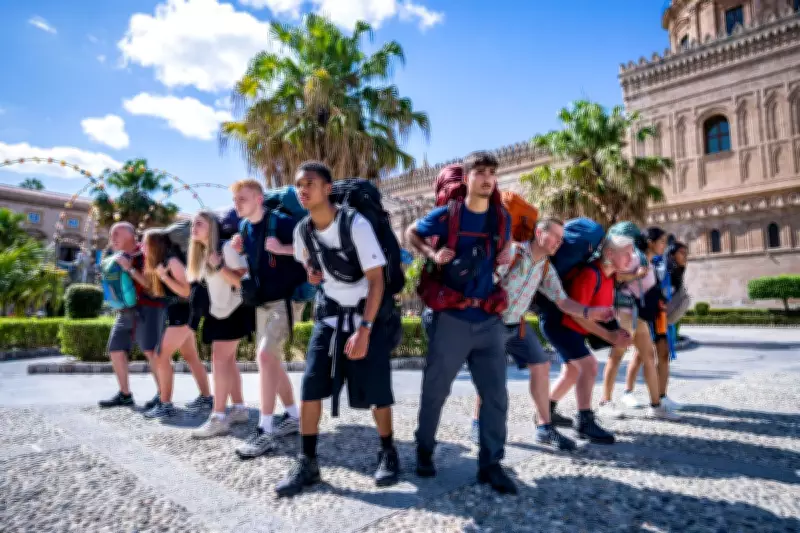
Race Across the World has concluded for another year, featuring its most extreme competition to date. This season, five teams competed to be the first to reach the finish line in rural Mongolia, traversing 7,400 miles across Europe and Asia along the ancient Silk Road.
The Starting Point: Palermo, Sicily
The race began in Palermo, the capital of Sicily. Teams navigated routes across southern Italy, passing through Naples, Sorrento, Puglia, and the Calabrian coast. They surrendered their bank cards and phones at Palermo's 12th-century Baroque cathedral, the Church of San Giuseppe dei Teatini. Palermo is renowned for its Romanesque, Gothic, and Baroque architecture, as well as its Unesco-protected Norman palaces and churches. The city's Mediterranean climate and Sicilian cuisine, including arancini and pasta alla norma, attract many tourists.
Checkpoint One: Fiskardo, Kefalonia, Greece
The first checkpoint was the village of Fiskardo on the northern tip of Kefalonia, the largest Ionian island. This upscale harbour resort is popular with yachters and features original Venetian buildings from the 1500s to 1797. Visitors can enjoy family-run restaurants, cafes, and bars along the waterfront, as well as pebble beaches and bays ideal for swimming, scuba diving, and kayaking.

Checkpoint Two: Istanbul, Turkey
After a 186-mile journey through rural Greece, Athens, and Mount Olympus, teams reached Istanbul, one of the world's most-visited cities, drawing over 19 million tourists annually. Straddling Europe and Asia on the Bosphorus Strait, Istanbul is known for its spice and jewellery bazaars, over 3,000 mosques, and iconic sites like the Hagia Sophia. The city offers diverse cuisine, from Turkish breakfasts to fish sandwiches (balik ekmek) and strong coffee.
Checkpoint Three: Halfeti, Turkey
In this leg, the last team to reach the checkpoint was eliminated. Teams raced from Istanbul to Halfeti on the southeastern border. Halfeti's old town was submerged by the Birecik Dam in 2000, leaving a partially sunken minaret visible from boats. Visitors can explore the underwater ruins, and the area is popular for diving. Teams had to reach a viewing platform opposite Rumkale Castle, a ruined Byzantine fortress on a large rock.
Checkpoint Four: Tbilisi, Georgia
After one team's elimination, the remaining pairs travelled 1,050 miles to Tbilisi, Georgia's capital. The city's 1,500-year history is reflected in its diverse architecture, from medieval domed sulphur baths to Soviet tower blocks and modern buildings. Georgian cuisine features khinkali dumplings and mchadi cornbread, and the country is famous for its wine, particularly the Chinuri white grape variety.
Checkpoint Five: Zaamin National Park, Uzbekistan
Teams travelled 1,300 miles from Tbilisi to Zaamin National Park in Uzbekistan. With the land border closed between Georgia and Azerbaijan, they flew to Aktau, Kazakhstan, before continuing. Their goal was the Suffa Plateau, part of the Turkestan mountain range, nicknamed Uzbek Switzerland. The park features alpine meadows, deep valleys, and over 150 species, including Siberian ibex and Turkestan lynx. The Suffa Plateau sits at 2,500 metres, requiring teams to cope with thin, cool mountain air and a steep cable car ride.
Checkpoint Six: Almaty, Kazakhstan
For the sixth checkpoint, teams travelled 1,500 km to Almaty, Kazakhstan's largest city, known as the cultural and financial hub. Its name means 'place of apples' due to wild orchards in the Tian Shan foothills. The city features Soviet-era relics like the Ascension Cathedral and the Memorial of Glory and Eternal Flame in Panfilov Park.
Checkpoint Seven: Kharkhorin, Mongolia
Entering the final country, teams navigated freezing conditions and endless plains to reach Kharkhorin, once the imperial capital under a son of Genghis Khan. The town is scattered with ruins and sacred monasteries, including the Erdene Zuu monastery built in 1585, a rare survivor of the Stalinist purge. Kharkhorin lies within the Unesco heritage Orkhon Valley Cultural Landscape, still grazed by Mongolian nomadic pastoralists.

The Finish Line: Hatgal, Mongolia
After the 7,400-mile trek, teams reached the finish line in Hatgal, a remote village on the shores of Lake Hövsgöl. Temperatures here can drop to -49°C in January. The lake, known as the Blue Pearl, is one of 20 ancient lakes on Earth, existing for about two million years. Each March, a festival on its frozen surface includes ice skating, horse sleigh racing, ice sumo wrestling, and Shamanic rituals.